

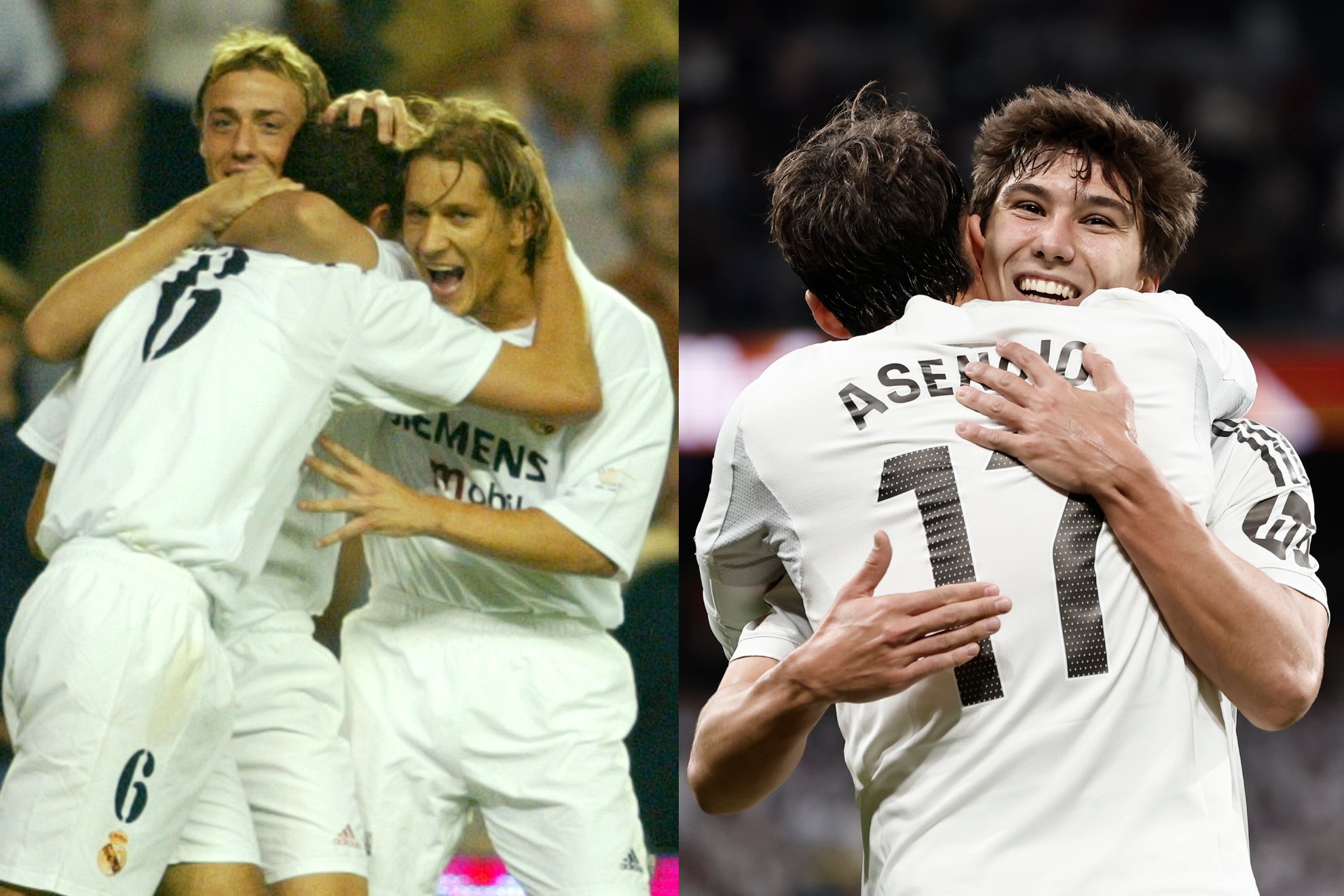
Madrid's Spanish goal drought: 24 years since last all-Iberian rout
From Raúl and Guti in 2002 to today's rare Spanish goal-fest - how Madrid's Spanish goalscoring identity has transformed over a generation.
A remarkable statistical oddity emerged from the Bernabéu this weekend that highlights just how dramatically Real Madrid’s Spanish identity has evolved over a generation.
Spanish scoring drought ends
For the first time in nearly 24 years, Real Madrid won a match by scoring three or more goals with all of them coming from Spanish players. You have to go all the way back to September 14, 2002 - a 4-1 victory over Osasuna - to find the last time this happened.
That day featured a Helguera brace alongside goals from club legends Raúl and Guti. Fast forward to 2026, and the current crop of Spanish talent has finally matched this feat against Real Betis - though in circumstances that reveal how profoundly the club’s makeup has changed.
A tale of two eras
The contrast between these matches separated by nearly a quarter-century couldn’t be starker:
- 2002: Madrid started with six Spaniards (Casillas, Salgado, Hierro, Helguera, Guti, Raúl)
- 2026: Only three Spanish players made the starting XI (Asencio, Carreras, Gonzalo)
What’s more telling is that in 2002, Madrid eventually fielded nine different Spanish players throughout the match. At one point, seven Spaniards were on the pitch simultaneously as Celades joined the fray.
Against Betis, even with the introductions of Fran García and Dani Ceballos from the bench, the maximum number of Spaniards on the pitch at any one time was just four.
Football’s changing landscape
This stark contrast isn’t just about team selection policy - it reflects profound shifts in football’s landscape. In the early 2000s, having a Spanish spine was the norm at Madrid. Today, an all-Spanish goalscoring display is practically a statistical anomaly.
The transformation speaks volumes about how the club has evolved alongside changes in the transfer market and football’s increasingly global talent pool. Where once the Bernabéu showcased primarily homegrown heroes, today’s Madrid represents a truly international constellation of stars.
That it took nearly 24 years for this scoring pattern to repeat itself isn’t coincidence - it’s a perfect illustration of how the beautiful game and its most successful club have changed before our eyes.